

Robotics & Automation Outreach Program (RAOP)
An NSF-funded summer research and professional development program hosted by the AVRC Laboratory at Howard University. Designed for pre-service and in-service STEM educators through a structured 2-week virtual + 1-week on-site research experience in robotics and automation. Educators connect guided inquiry-based learning with teaching in their schools.
Eight educators · Virtual: July 6–17, 2026 · On-site: July 20–24, 2026
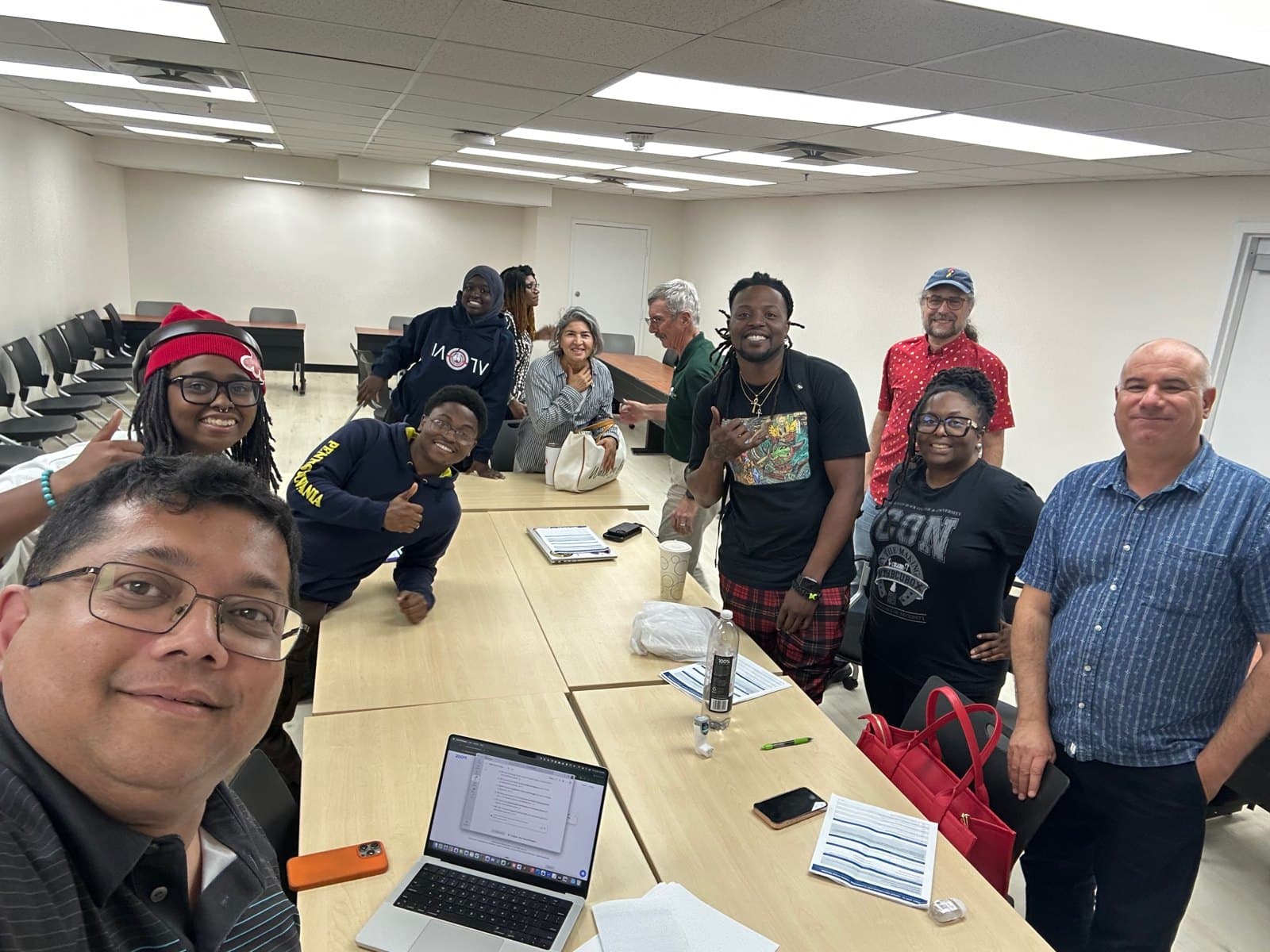
STEM educators · Howard University
Discover RAOP 2027
Explore a three-week research experience in robotics and automation: two weeks of virtual learning, followed by one week in the AVRC Laboratory.
Participant support of up to $5,900 includes stipends, housing, and transportation, subject to eligibility and program requirements.
2027 planning: applications are not yet open. Dates are proposed.
Research experience → school teaching
How RAOP Connects Learning and Teaching
Stage 1
Prepare
Software access, Onramps, and a teaching question
Stage 2
Investigate virtually
Two weeks with MATLAB, Simulink, and QLabs
Stage 3
Work in the laboratory
One week with supervised hardware rotations
Stage 4
Adapt for school
Plan, try, gather evidence, and refine
Guided inquiry-based learning connects each stage: ask a question, make a prediction, test, interpret evidence, and reflect. T1–T6 and school follow-up inform curriculum improvement.
Research Experience and School Teaching
RAOP is Howard University’s NSF Robert Noyce–funded Research Experiences in STEM Settings (RESS) initiative in the Autonomous Vehicle, Robotics & Control (AVRC) Laboratory. Its central objective is to help educators bring robotics and automation learning back to their schools through courses, curriculum units, after-school activities, and clubs. The program encourages continued investigation and guided inquiry-based teaching.
Each year, RAOP selects eight pre-service and/or in-service STEM educators for an intensive three-week summer cycle. In 2026, eight educators used MATLAB, Simulink, and Quanser QLabs digital twins before investigating physical systems in the laboratory. Educator experience and assessment evidence inform an adaptable grades 6–12 curriculum that will be expanded, evaluated, and refined across five annual cycles.
Housing support is intended for eligible non-local participants during the on-site week. Amounts are budget allocations; individual housing, travel, and payment arrangements are confirmed with the RAOP team.
What participants gain
- A structured simulation-to-hardware experience using QLabs digital twins and AVRC physical platforms.
- Guidance for adapting research activities to grades 6–12 STEM teaching and available school resources.
- Access to program materials, lab guides, and curated technical resources used throughout the RAOP cycle.
- Faculty and technical support for onboarding, lab execution, and curriculum adaptation.
2026 cycle: school integration and follow-up
The summer training is complete. Follow-up with educators is planned for October 2026 to document how they use or adapt their learning in schools and identify further support needs.
Contact the project team for information about future participation.
Program Structure
The 2026 pilot connected preparation, virtual investigation, and supervised laboratory experience. Educators practiced asking questions, making predictions, collecting data, and explaining results before planning activities for their own teaching contexts.
- Preparation: MathWorks approved a STEM Outreach License for MATLAB and Simulink. Access was shared with participants one month before the program, supporting preparation through MATLAB Onramp and Simulink Onramp.
- July 6–17, 2026 — Virtual phase: Educators worked in pairs on assigned platform activities using MATLAB, Simulink, and QLabs digital twins, with guidance from the RAOP team. They explored the connections between software commands, sensors, actuators, and measured system behavior.
- July 20–24, 2026 — On-site phase: Educators rotated through all four core platforms in the AVRC Laboratory, comparing virtual and physical behavior, interpreting measurements, and developing ideas for school teaching. Advanced demonstrations included QDrone 2 mission control with OptiTrack localization and Motive software.
- Continuous Improvement: After each cycle, feedback from participants, training assistants, and the advisory committee is analyzed to refine the next year’s activities, curriculum, and assessment instruments.
Core Platforms and Learning Objectives
The pilot used four pairs for virtual activities and rotations across all four platforms on site. Introductory activities emphasize sensors, actuators, data collection, and the relationship between commands and measurements. Advanced control theory and robot kinematics are extensions rather than prerequisites.
Qube-Servo 3 — Motor, Encoders, and Feedback▶
Identify the DC motor, encoder, inertia disk, and pendulum attachment. Explore how software reads position measurements and sends commands through the hardware interface. Use recorded data to explain motion and the purpose of feedback.
Aero 2 — Pitch, Yaw, and Coupled Motion▶
Observe how rotor inputs affect pitch and yaw in a laboratory helicopter model. Compare commanded and measured angles and use observations to introduce systems with multiple inputs and outputs.
QArm — Joint Motion, Sensing, and Manipulation▶
Identify joints, actuators, and sensing functions. Explore supervised motion sequences and pick-and-place tasks, connecting measured joint position and programmed actions with geometry, sequencing, and introductory computing.
QBot Platform — Mobile Robotics and Sensing▶
Explore a mobile ground robot, wheel motion, and sensor measurements. Compare virtual and physical observations and plan investigations that connect data collection, movement, and introductory navigation.
Professional Development, Curriculum, and Assessment
RAOP is structured as a coherent professional development sequence that links authentic research-style experiences with concrete classroom products.
- Guided Inquiry-Based Learning: Experiments are framed as inquiry-based labs in which educators pose questions, analyze data, and justify evidence-based conclusions.
- School Integration: Educators plan ways to adapt activities to their students, courses, and clubs. The educator guide provides a foundation for this work; school implementation will be documented through follow-up.
- T1–T6 Assessment Framework: T1 documents setup readiness; T2 records virtual laboratory checkpoints; T3 records on-site hardware checkpoints; T4 gathers participant feedback; T5 supports group discussion and classroom integration planning; and T6 gathers advisory board feedback. Together, these tools guide program improvement.
- Continuous Improvement: Participant feedback and advisory input are used to refine materials, rubrics, and support resources for the next cycle.
Program Partners and Resources
MathWorks supported software access through the approved STEM Outreach License for MATLAB and Simulink, complemented by Onramp preparation resources.
Quanser is the industrial partner associated with the robotics platforms, QLabs digital twins, technical resources, and instructional support. These resources help connect software-based investigation with physical laboratory experience.
Explore program and technical resourcesProject Team
RAOP is led by an interdisciplinary team from Howard University’s College of Engineering and Architecture and School of Education.
- PI – Dr. Fadel Lashhab, Department of Electrical Engineering & Computer Science; Director of the Autonomous Vehicle, Robotics & Control (AVRC) Laboratory.
- Co-PI – Dr. Katherine Picho, educational psychology and evaluation; leading assessment design and analysis.
- Co-PI – Dr. Imtiaz Ahmed, supporting recruitment and selection, advisory board moderation, and the T5 group discussion and T6 advisory feedback summaries.
Contact
For questions about eligibility, application details, or collaboration opportunities, please contact:
Dr. Fadel Lashhab – fadel.lashhab@howard.edu
Follow RAOP & stay connected
Program updates, announcements, and educator highlights.
Instagram links to Fadel Lashhab’s profile. Some social platforms may require sign-in.